
How does ENERWA perform water quality sampling?

What do we measure and why is it important?
-
Air and water temperatures
-
pH
-
Total nitrogen
-
Conductivity
-
Total phosphorus
-
Dissolved oxygen
-
Water clarity (turbidity)
Nitrogen, phosphorus, and sediment are the three pollutants addressed by the Chesapeake Bay’s “pollution diet” over- seen by the federal Environmental Protection Agency (EPA). In our measurements, total nitrogen, total phosphorus, and water clarity are the parameters that directly relate to these pollutants. Conductivity is another measure of undesirable solids dissolved in water, and dissolved oxygen tells us how well a waterway can support plant and animal life.
What about bacteria? The Cecil County Health Department monitors the bacterial content of both rivers May-August and posts its results online.
What sites does ENERWA monitor?
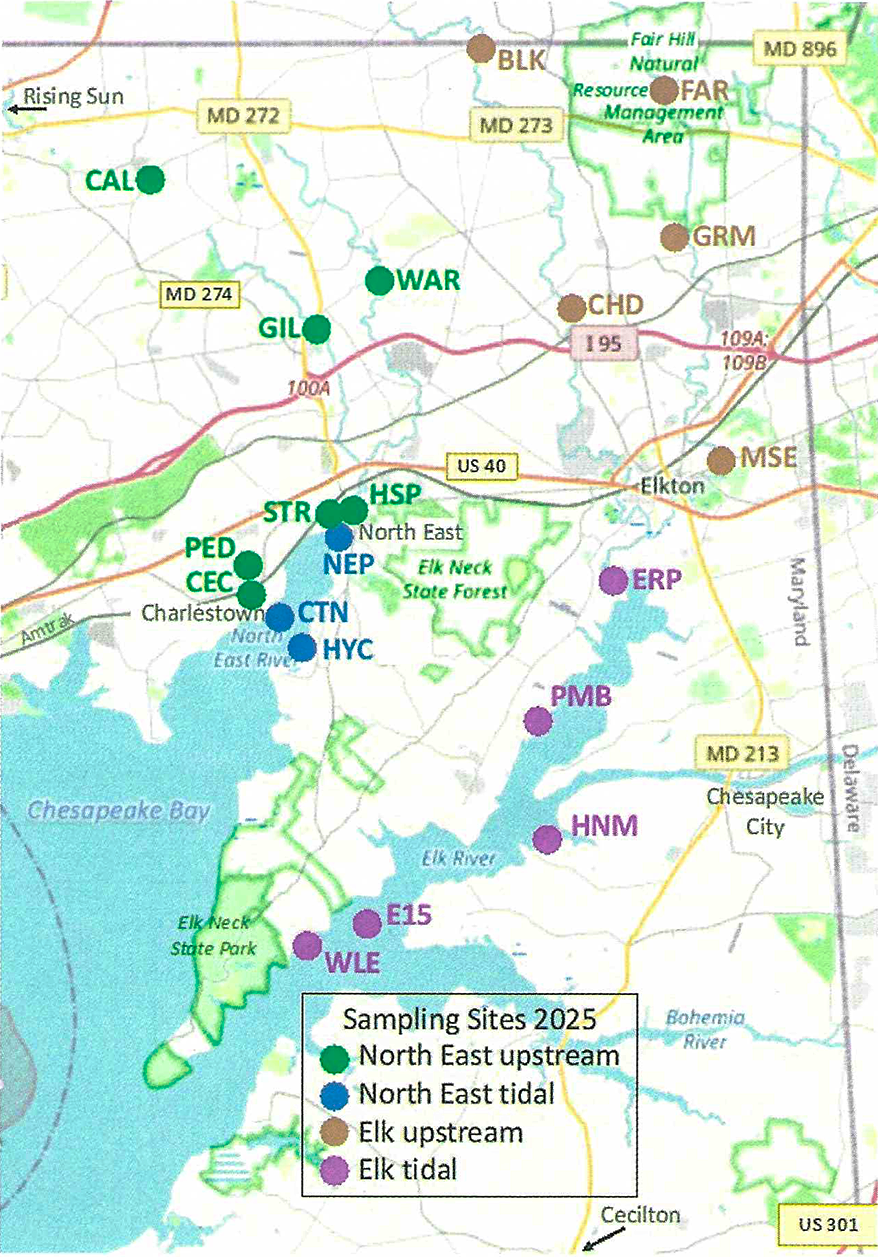
The map below shows the sites that ENERWA monitored in 2025: 10 sites in the North East River watershed and 10 sites in the Elk River watershed.
North East River Watershed
Elk River Watershed
How do we calculate the grades?
You can view the raw ENERWA data from each site on the Chesapeake Monitoring Cooperative (CMC) Data Explorer, which is maintained by the Alliance for the Chesapeake Bay. Data from 2026 is already being posted there.
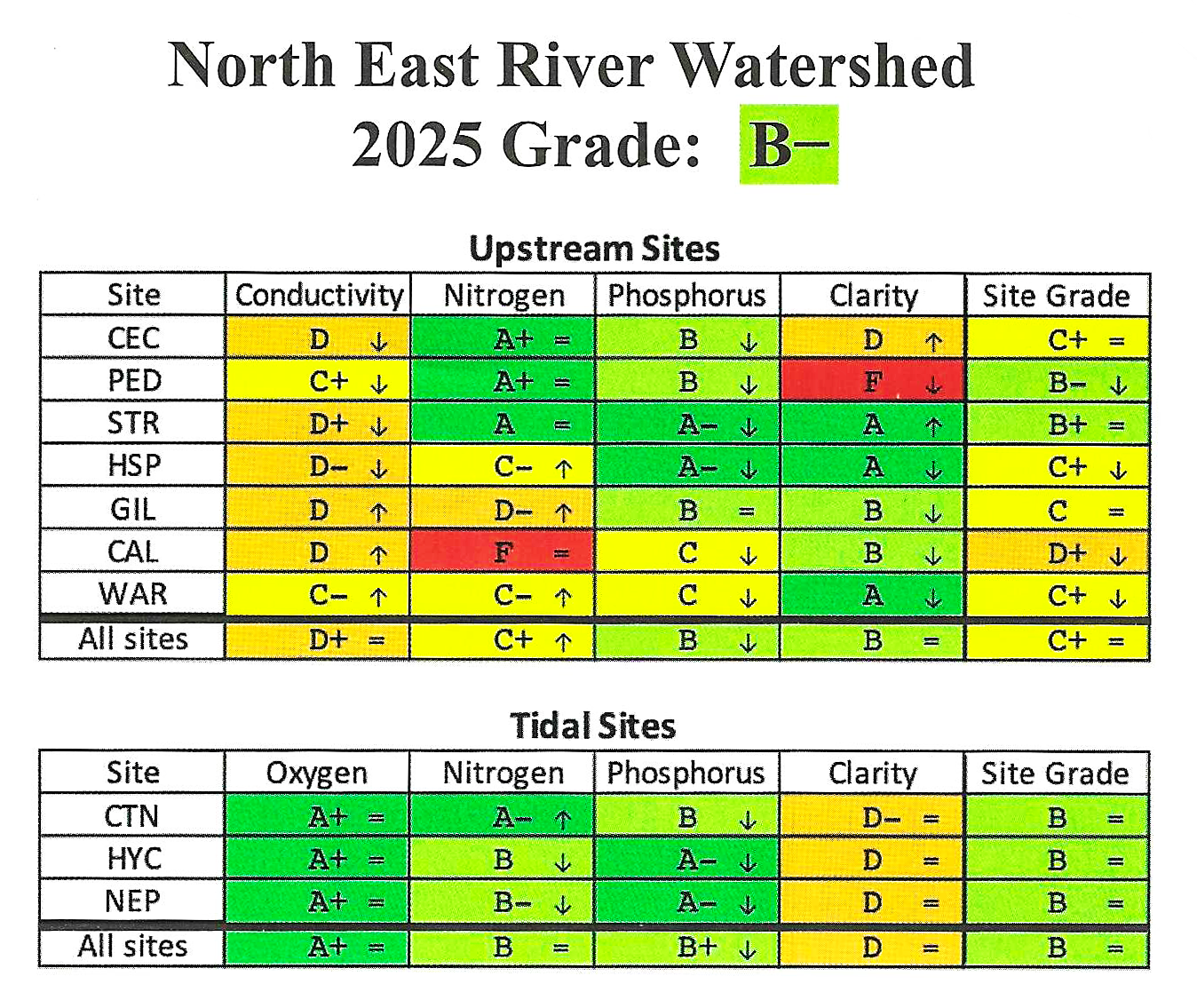
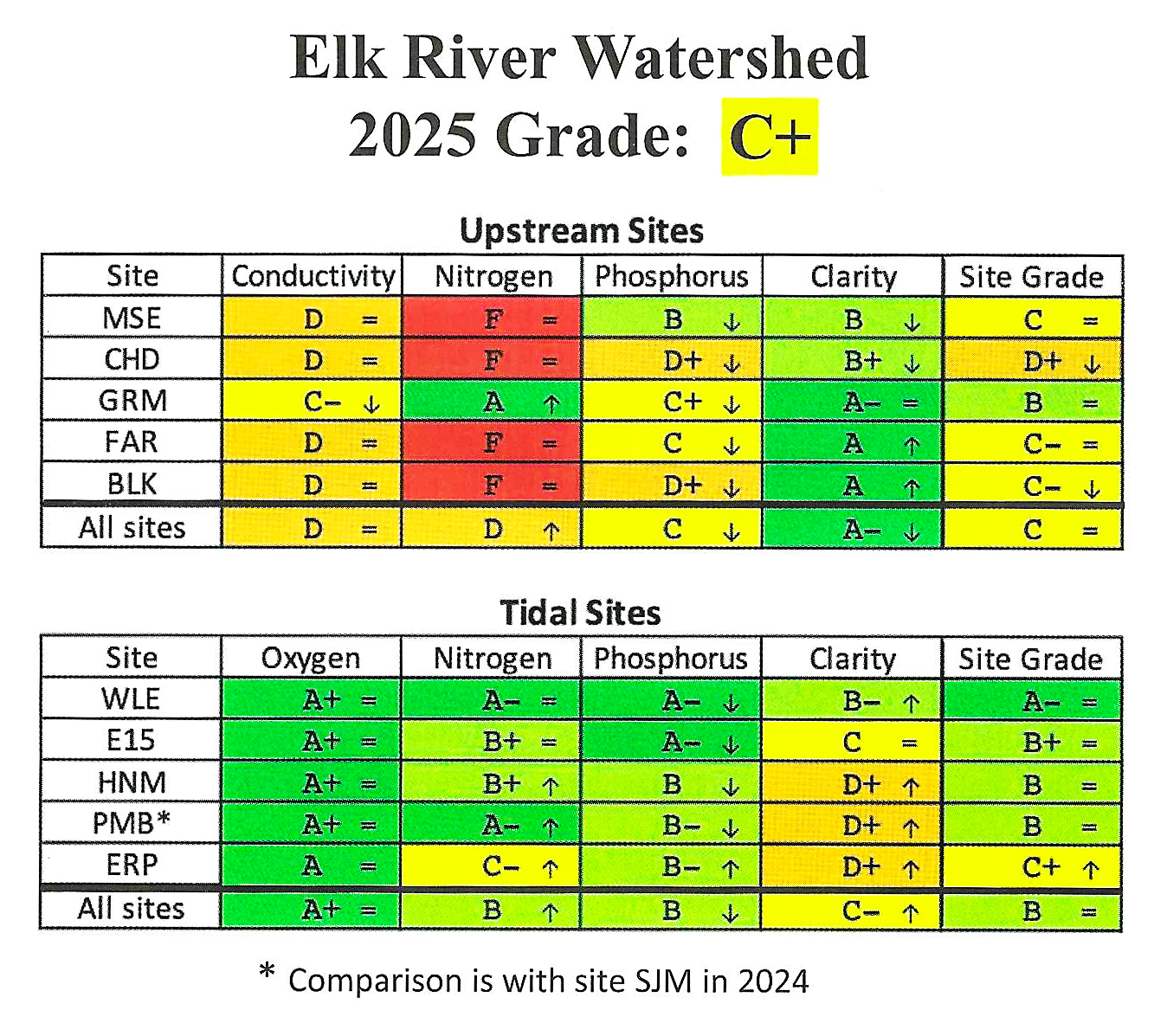
The tables above show the complete scorecards, according to the MTAC protocols, for our 2025 measurements. Dissolved oxygen is not scored for the upstream sites (although it is used as a check) because oxygen is generally good in flowing streams. Conductivity is not scored for tidal sites because it is very sensitive to changes in salinity (salt content).
The changes in the detailed scorings from 2024 to 2025 are indicated by the small marks on the right side of each box in the tables, where ↑ means a better score in 2025, ↓ means worse, and = means the scores for the two years are the same. Site PMB (on the tidal Elk) in 2025 replaced nearby site SJM in 2024, so for the year over year comparison, we have considered them to be at the same location.
As in previous years, many of the upstream sites, especially in the Elk watershed, show high nitrogen content, which can come from agricultural runoff, septic systems, or overfertilized lawns. In 2025, we also saw an increase in phosphorus compared to previous years (lots of ↓ symbols in the Phosphorus column). Because we do not have large numbers of chicken farms like the lower shore, which has a significant phosphorus problem, this increase is a mystery. The nitrogen and phosphorus in the water tends to get diluted in the tidal sites, but these sites show poor water clarity, which can inhibit the growth of underwater grasses that are the basis for a healthy ecosystem.
We are also in contact with the Maryland Department of the Environment about high pH values that we have consistently measured in the tidal part of the North East River over the last few years. These values indicate basic or alkaline water there.
The overall Elk River watershed score was a C+ in 2025, a downgrade from a B− in 2023 and 2024. The North East watershed received an overall grade of B− in 2025, the same as in 2023 and 2024.